
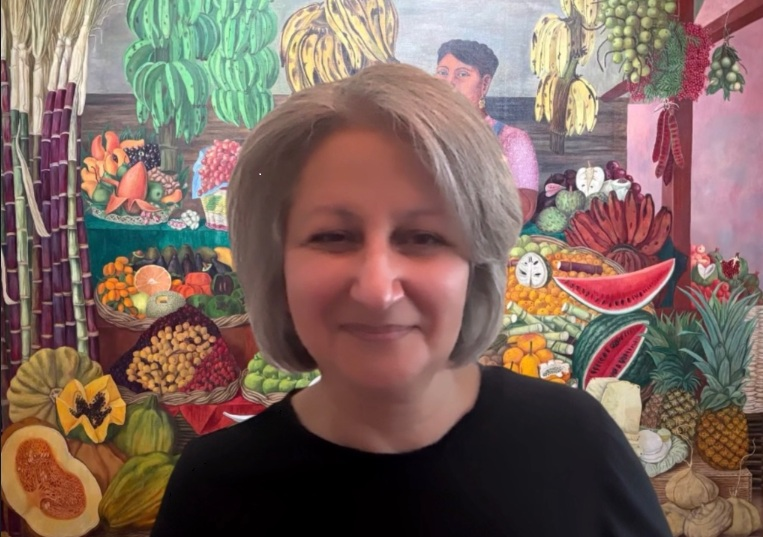
Please meet Vibha Pingle, our new ECG Social Committee Co-Chair, a dynamic, socially committed neighbor who has lived at the Esplanade for 19 years.
Vibha grew up in Delhi, the only child of a scientist/engineer father and a former librarian mother who was active in volunteer social work.
But she does not think it was a“classically Indian” childhood. Her parents were deeply feminist, very environmentally conscious; in fact, she remembers her father “lecturing me about global warming when I was in kindergarten.” This was unusual in India. She grew up in a “lovely global bubble.”
After graduating from Delhi University, she got her MA and PhD in sociology at Brown University. While she loved her time at Brown, it was only after she graduated that she found the work that would become her passion, the study of gender and poverty. She received a Ford Foundation grant to spend several years in South Africa, to study: what strategies women who successfully escaped entrenched poverty used? She hoped to use this knowledge to inform anti-poverty policy. While there, she interviewed people throughout the country and found it to be a “life-changing experience.” She had been raised to be a feminist, but wasn’t actually aware of how sexist the world was. Even when she came to the U.S. and became more aware of micro-aggressions, she found that what she had learned at home wasn’t enough of an answer. What she found in South Africa was women who were living with poverty, AIDS, violence, and yet they were stronger than even some of the privileged “feminist” women here, stronger than she felt she had been prepared to be. It was the support of women around them that sustained them. You needed a community of support—a “courtyard of sisterhood.”
Vibha’s life trajectory would take her through several professional positions, teaching posts at Rutgers and Notre Dame, and a fellowship in England. She would fall in love, live in Cambridge in the 1990s with her husband, then in New York City, South Bend, Brighton in the UK, and Vermont, and return to Cambridge about 20 years ago. Their son was born in England as her husband commuted to his job in Michigan. It was in England, raising their child mostly alone, where she really began to personally feel the need for what she had witnessed in South Africa, the community of sisterhood. She moved to Vermont for several years, a place she and her family still dearly love, and then took a consulting job at Fidelity, creating an in-house journal on world events and social currents. Her son has grown up in the Esplanade, where many neighbors still remember him as a child, regularly walking their dog.
One of Vibha’s reasons for taking the job at Fidelity was that she wanted to start her own non-profit organization and to learn about financial issues. When the stock market crashed in 2008, she started Ubuntu, which began as several pilots in southern Indian villages, then in Bali, Indonesia, Limpopo, and Soshanguwe in South Africa, and most recently along the Kavango river in Namibia. The basic model of Ubuntu is to enter a community of economically vulnerable women and help them engage in economic activities of their choosing that can help them escape poverty Ubuntu provides skills training, financial literacy, equipment, supplies as needed, and spends time developing their courtyard of sisterhood, that core value that Vibha had seen so vividly during her earlier years in South Africa. Once the community succeeds, Ubuntu leaves in search of other disadvantaged communities. Many of us have seen the beautiful baskets that Vibha sells at local art fairs. These baskets are produced by women in villages in northern Namibia who want to start chicken farming to improve their economic situation.
The women don’t have a good local market for their baskets, so Ubuntu sells the baskets here for more than they can be sold locally. The women get 100% of the proceeds and use the profits to build their chicken farming project. And the Ubuntu staff in Namibia supports the women as required.
Ubuntu has been an incredibly rewarding project. Vibha used to visit projects once or twice a year, but travel has become so expensive that she has decided that the money is better used to provide in-country support.
Since 2016, Vibha has taught part-time at Brown. Her course, “Justice, Gender, and Markets”, is about women, their work, and communities through history and how their experiences can inform policies about gender justice and women’s pathways out of poverty. Students learn the common experiences and strategies women have drawn upon through history and around the world. She believes we can’t achieve gender justice here or anywhere until people understand the deep extent to which our challenges are similar despite the obvious vast differences in opportunities and resources. She is also working on a book, to be titled “Letters to My Son,” a less academic and more personal project.
Vibha brings her life experiences and interests to her role as the ECG Social Committee Co-Chair, along with Nancy Crowley. She is launching a film series and has hosted documentary screenings and subsequent discussions with the hope of building on our collective experiences and expanding the horizons of our Esplanade “bubble.” She has a strong sense that what builds community is face-to-face interpersonal interaction and hopes to bring more of us together to build our community of neighbors. She welcomes your input on social events you would like to see at the Esplanade. We are very lucky to have this inspirational woman as a neighbor and welcome her leadership in our community.
From Vibha to all of you, “Thanks to all neighbors over the past 19 years who’ve not been just wonderful neighbors, but also wonderful neighbors to our son, who has grown up here and is graduating this May.”
~Barbara Ogur